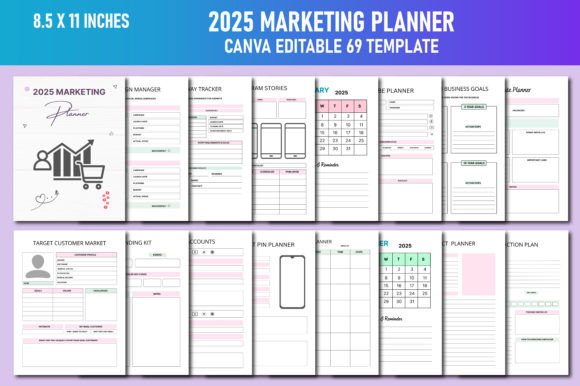
2025 Marketing Planner Canva KDP: A Practical Evaluation for Planners, Creators, and Small Business Owners
The 2025 Marketing Planner Canva KDP is a digital planning resource designed specifically for entrepreneurs, solopreneurs, content creators, and small business teams who need structure—but also flexibility—in their marketing workflow. Unlike static PDF planners or generic notebooks, this version is built for customization and real-world application: it’s delivered as a suite of high-quality, print-ready files (JPG, PNG, PDF) plus an editable Canva link. That dual format—ready-to-print assets paired with cloud-based editability—makes it distinct among digital planners targeting the 2025 planning cycle.
What Sets the 2025 Marketing Planner Canva KDP Apart
At its core, the 2025 Marketing Planner Canva KDP bridges two common needs: professional-grade output and hands-on adaptability. The interior pages are pre-designed in popular physical sizes—including US Letter (8.5" × 11"), A4, and sometimes 6" × 9"—so users can print at home, use a local print shop, or order professionally bound copies via KDP (Kindle Direct Publishing). But unlike fixed-layout KDP interiors that lock you into one design, this planner includes an editable Canva link. That means you’re not just buying a template—you’re getting access to a living document you can modify: change colors, swap fonts, adjust layouts, add your logo, or delete sections you don’t use.
Its scope is comprehensive without being overwhelming. It covers cross-platform planning—from Instagram post scheduling and Pinterest board strategy to YouTube content calendars and Facebook ad tracking—as well as foundational business tools like competitor analysis, keyword research prompts, budget trackers, income logs, and long-term goal mapping. Importantly, these aren’t decorative placeholders. Each section includes functional headers, dated grids, checkboxes, and structured fields meant to support consistent input—not just aesthetic appeal.
How It Compares to Other Planning Approaches
When evaluating options, it helps to consider three broad categories: print-only planners, digital-native apps, and editable template kits. The 2025 Marketing Planner Canva KDP sits firmly in the third group—but with notable nuances.
- Print-only planners (e.g., bound journals or pre-printed monthly pads) offer tactile satisfaction and zero tech dependency—but they lack customization, can’t be updated mid-year, and rarely include integrated digital marketing frameworks like Instagram Stories trackers or SEO keyword logs.
- Digital-native apps (like Notion, ClickUp, or Trello) provide powerful automation, syncing, and collaboration—but require setup time, learning curves, and ongoing subscription costs. They also don’t produce print-ready outputs unless manually exported and reformatted.
- Editable template kits—like the 2025 Marketing Planner Canva KDP—offer middle-ground utility: no subscriptions, no installation, and immediate usability across devices via Canva’s free tier. You get the visual polish of a designed product with the control of a DIY tool.
This makes the 2025 Marketing Planner Canva KDP especially useful for people who want clarity without complexity—for example, a service-based freelancer launching a new offer in Q1 2025 and needing to coordinate social posts, email sequences, and budget allocation—all while keeping hard-copy notes during client meetings.
Strengths and Realistic Tradeoffs
Strengths:
- Immediate usability: No onboarding or configuration needed—open the Canva link, duplicate the template, and start editing.
- Consistent formatting: Because all pages share the same design language (fonts, spacing, color palette), printed or exported versions feel cohesive—even when customized.
- Multi-format output: JPG/PNG for quick sharing or social previews; PDF for printing or emailing; Canva link for live collaboration or iterative updates.
- Platform-agnostic coverage: Sections reflect actual workflows—not just “social media” broadly, but separate trackers for Instagram Ads vs. organic Stories, Pinterest analytics vs. pin ideation, LinkedIn content cadence vs. Twitter thread planning.
Tradeoffs to consider:
- It doesn’t auto-populate dates or sync with external calendars—users manually enter month names, deadlines, or campaign windows.
- While editable in Canva, advanced features like conditional logic, formulas, or database linking aren’t available—so income trackers or budget summaries remain manual calculations.
- It assumes baseline familiarity with Canva’s interface. First-time users may spend 20–30 minutes learning how to resize text boxes or export print-safe PDFs.
- No built-in guidance on *how* to complete certain sections—e.g., the Competitor Analysis page provides columns for name, strengths, weaknesses, and differentiators, but doesn’t walk through sourcing or interpreting that data.
Best-Fit Situations—and When to Look Elsewhere
The 2025 Marketing Planner Canva KDP works best when:
- You prefer working with tangible materials (printed pages, sticky notes, highlighters) but also need to iterate digitally—say, updating a product launch timeline after feedback from a team call.
- Your marketing efforts span multiple platforms and formats, and you’ve found generic planners too vague or overly specialized tools too fragmented.
- You run a solo operation or small team with limited budget for SaaS tools—and value one-time purchase over recurring fees.
- You’re preparing for a specific 2025 initiative: a rebrand, course launch, e-commerce store rollout, or local shop expansion—and want aligned planning across branding, content, ads, and finances.
It may be less ideal if:
- You rely heavily on automated reminders, calendar sync, or real-time collaboration with remote teammates—tools like Google Sheets + Calendar or Asana better serve those needs.
- You need deep analytics integration—e.g., pulling Instagram engagement metrics directly into your planner. This version supports manual logging only.
- You’re managing enterprise-level campaigns with complex stakeholder approvals, version history, or audit trails. In those cases, dedicated marketing ops platforms offer more governance.
- You prefer handwriting exclusively and don’t plan to print or edit digitally—the editable Canva component adds little value, and simpler printable-only planners may cost less.
Practical Use Cases Across Roles
A freelance graphic designer might use the 2025 Marketing Planner Canva KDP to map out quarterly content themes, schedule portfolio updates across Behance and Instagram, track outreach to ideal clients, and log monthly income against projected goals—all in one place, then print key pages for studio wall displays.
A boutique coffee shop owner could adapt the “Pre-launch costs” and “Target Customer Market” sections to refine their spring 2025 loyalty program rollout—then use the “Social Media Planner” to stagger Instagram Reels, Facebook event posts, and Pinterest menu graphics across March and April.
A course creator launching a new workshop in June 2025 might combine the “Content Ideas” and “YouTube planner” pages to outline video scripts, repurpose clips into Instagram carousels using the “Instagram post planner,” and monitor ad spend in the “Facebook Advertising Tracker”—all while referencing the “Annual Profit Loss” sheet to model revenue impact.
Making an Informed Choice
Choosing a planner isn’t about finding the “best” one—it’s about matching structure to your current capacity, goals, and constraints. The 2025 Marketing Planner Canva KDP delivers strong alignment for people who value intentionality, cross-channel coordination, and physical-digital hybrid workflows. Its strength lies not in novelty, but in thoughtful execution: each section reflects real marketing tasks, not abstract concepts. And because it’s built for Canva—a platform most users already know—the barrier to entry stays low.
If your priority is speed, consistency, and ownership over your planning system—without locking into subscriptions or sacrificing print quality—the 2025 Marketing Planner Canva KDP warrants serious consideration. Just keep in mind what it doesn’t do: it won’t replace your accounting software, automate your posting, or teach you SEO strategy. It’s a framework—not a substitute for judgment, effort, or learning. Used that way, it becomes a reliable companion for navigating the practical work of marketing in 2025.