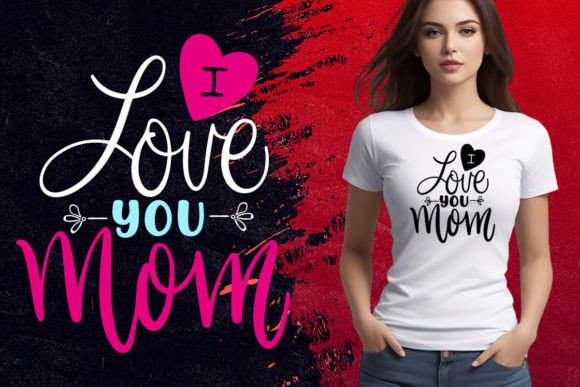
I Love You Mom T Shirt Design
There’s something quietly powerful about a well-crafted I Love You Mom T Shirt Design—it’s more than apparel. It’s appreciation made wearable, gratitude made visible, and love made shareable. Whether you’re designing for Mother’s Day, a family reunion, a custom gift shop, or your own print-on-demand store, this design resonates across generations. Its versatility lies not just in sentiment—but in execution: clean typography, thoughtful spacing, and scalable vector integrity make it suitable for everything from soft cotton tees to ceramic mugs and embroidered hoodies.
Why This Design Stands Out (and Why It’s Often Misused)
Unlike generic text-based graphics, a high-quality I Love You Mom T Shirt Design is built with real-world production in mind. The version described here includes six professional-grade files—PNG (4500×5400 at 300 dpi with transparent background), EPS, JPG, AI, PDF, and a compressed ZIP—and that matters more than many buyers realize. Yet, too often, people download the design without checking *how* each file serves a purpose—or worse, assume “any format will do.” That assumption leads directly to blurry prints, cut-file failures, or mismatched colors on dark garments.
Common Oversights—and What They Cost You
- Using the JPG for large-format printing: JPGs are great for web previews but lack transparency and resolution headroom. Print it on a 16”x20” poster or oversized hoodie? You’ll see pixelation around edges, especially with fine typography. A better choice: use the PNG for screen printing or DTG, and the EPS or AI for vector-based embroidery or vinyl cutting.
- Ignoring DPI and dimensions when sizing for mugs or pillows: That 4500×5400 PNG isn’t arbitrary—it’s sized for crisp reproduction up to 15”×18” at 300 dpi. Shrinking it down for a 12oz mug without resampling properly can distort letter spacing or thin strokes. Always scale proportionally *within your design software*, not by dragging corners in basic editors.
- Assuming “transparent background” means “ready for any fabric color”: Transparency helps—but if your printer uses white underbase (common on dark shirts), you’ll need to confirm whether the design includes knockout settings or layer instructions. The included PDF often contains production notes; skip it, and you risk misaligned white ink or faded text on navy or charcoal.
- Forgetting file extraction steps: The ZIP delivery is practical—but beginners sometimes open the archive and try to upload a folder instead of extracting first. WinRAR or 7-Zip aren’t optional extras here; they’re necessary to access individual files cleanly. Upload a zipped folder to Printful or Redbubble? Your listing may fail silently—or worse, render a placeholder image.
What to Verify Before You Use or Resell
Before applying the I Love You Mom T Shirt Design to your next product, take two minutes to verify these points—not as checklist rigidity, but as quality insurance:
- Open the AI or EPS in Adobe Illustrator (or compatible vector editor) and zoom to 400%. Look for stray anchor points, overlapping paths, or ungrouped layers. Clean vectors mean smoother cuts and consistent scaling. If letters appear jagged or disconnected at high zoom, the file wasn’t exported properly—even if it “looks fine” at thumbnail size.
- Check color mode: RGB is ideal for digital displays and DTG printing; CMYK is standard for offset or large-run screen printing. The PDF and AI files usually default to CMYK—but if you’re using it for KDP interiors or social media banners, convert to RGB first to avoid duller tones.
- Test the PNG on a mockup with a dark background. Transparency should hold—no gray halos, no faint white edges. If you see fringing, the PNG wasn’t saved with proper anti-aliasing against transparency. Re-download or contact the seller; it’s an easy fix, but one you shouldn’t overlook.
- Confirm licensing scope. Most reputable sellers grant commercial use for POD, small-batch apparel, and physical goods—but not for resale as standalone digital assets (e.g., selling the SVG on Creative Market). Read the license summary inside the ZIP or accompanying TXT file. When in doubt, email the creator. Clarity now prevents takedowns later.
Better Workflow Choices for Real Results
Let’s say you’re launching a Mother’s Day collection on Etsy. Instead of dropping the design onto five shirt mockups and publishing, try this:
First, use the AI file to adjust kerning slightly for readability on curved surfaces (like mug handles or pillow corners). Then, export fresh PNGs at exact dimensions needed per product—3000×3000 for mugs, 2500×3500 for throw pillows—always preserving transparency. Name each file clearly: mom_tshirt_front_300dpi.png, mom_mug_side_300dpi.png. This avoids confusion during bulk uploads and makes reordering easier.
If you're integrating into Canva or Cricut Design Space, start with the SVG equivalent—if available—or convert the EPS using Inkscape (free) before importing. Never paste a JPG into Cricut and hit “flatten.” You’ll lose cut lines entirely.
And for educators or small business owners creating classroom gifts or staff appreciation bundles: pair the design with a short handwritten note explaining *why* you chose it—“We picked this because it’s legible at any size, works on light and dark fabrics, and scales beautifully for embroidery.” That kind of intentionality builds trust far beyond the graphic itself.
Final Thought: Design Is Only as Strong as Its Execution
An I Love You Mom T Shirt Design carries emotional weight—but its impact multiplies when handled with care. It’s not about having *more* files. It’s about knowing which file solves which problem. It’s not about speed—it’s about verifying transparency before pressing “print,” checking vector integrity before sending to embroidery, and respecting licensing before listing on ten platforms. These aren’t restrictions. They’re guardrails that keep your message clear, your products professional, and your customers feeling seen. Because when someone wears “I Love You Mom,” they’re not just wearing a phrase. They’re wearing thoughtfulness—yours.