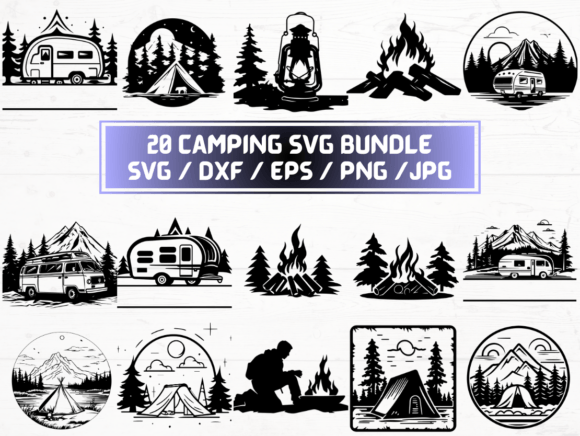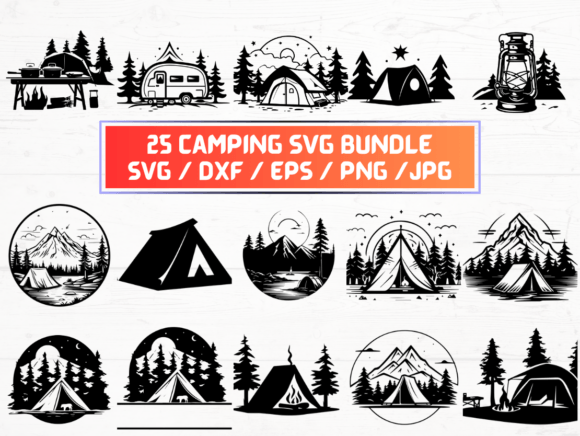
25 Camping SVG, DXF, EPS, JPG Files: A Versatile Digital Asset Suite for Creative and Technical Workflows
For designers, makers, educators, small business owners, and outdoor enthusiasts alike, vector and raster assets rooted in authentic, functional themes offer more than aesthetic appeal—they serve as foundational tools for communication, production, and instruction. The 25 Camping SVG, DXF, EPS, JPG collection exemplifies this convergence of utility and thematic relevance. Unlike generic clipart packs, this curated set reflects real-world camping motifs—tents, campfires, hiking boots, compasses, pine trees, lanterns, backpacks, trail markers, and more—each rendered with precision across five industry-standard file formats. Its value lies not only in visual fidelity but in cross-platform compatibility, enabling seamless integration into diverse creative and technical environments.
Why Format Diversity Matters Across Disciplines
One defining strength of the 25 Camping SVG, DXF, EPS, JPG bundle is its intentional multi-format structure. Each format serves a distinct functional niche—and understanding those distinctions helps users select the right file for the right task.
- SVG (Scalable Vector Graphics): Ideal for web-based applications, responsive design, and interactive interfaces. Because SVGs scale infinitely without pixelation, they’re frequently embedded in educational websites, mobile apps for outdoor education, or digital signage at parks and recreation centers.
- DXF (Drawing Exchange Format): Widely supported by CNC routers, laser cutters, and CAD software, DXF files are essential for physical fabrication. Hobbyists building custom gear organizers, educators running maker-space workshops, or small-batch manufacturers producing branded camping accessories rely on clean, layer-organized DXF data.
- EPS (Encapsulated PostScript): A legacy—but still widely accepted—vector format, especially in print production workflows. Graphic designers preparing brochures for outdoor outfitters or park service outreach materials often use EPS to ensure consistent color separation and high-resolution output on offset presses.
- JPG (Joint Photographic Experts Group): Though raster-based and resolution-dependent, JPGs remain indispensable for quick mockups, social media content, presentations, and documentation where file size and universal compatibility outweigh scalability needs.
- PNG (Portable Network Graphics): Included in this listing at 300 dpi with transparent backgrounds, PNGs bridge the gap between print-ready clarity and digital flexibility. They’re routinely used in e-commerce product displays, instructional infographics, and layered digital illustrations where background isolation is critical.
This breadth ensures that whether you're etching a trail map onto wooden trail signs using a diode laser (DXF), animating a campsite layout for an environmental science lesson (SVG), or designing reusable packaging for eco-friendly camping supplies (EPS), the same visual concept remains technically accessible—no re-drawing, no interpolation loss, no licensing ambiguity.
Real-World Applications Beyond Decoration
The 25 Camping SVG, DXF, EPS, JPG files are rarely used in isolation. Instead, they act as modular components within larger systems—educational curricula, small business branding, community engagement initiatives, or hands-on learning environments.
A middle school STEM teacher might import the tent SVG into a coding environment like p5.js to demonstrate coordinate geometry through interactive scaling and rotation. Simultaneously, the matching DXF file could be loaded into Tinkercad or Fusion 360 for students to modify structural elements before cutting scaled prototypes from balsa wood.
A regional tourism board may license or acquire such a pack to standardize visual language across visitor centers, trailhead kiosks, and printed maps—ensuring icon consistency while reducing design overhead. The EPS files allow for precise Pantone matching in large-format vinyl prints, while the transparent-background PNGs support dynamic overlays on augmented reality trail guides.
Small apparel businesses specializing in outdoor gear often use these assets to develop embroidery digitizing templates (via DXF import into Wilcom or Pulse) or screen-print separations (leveraging EPS paths). Because each of the 25 designs is delivered in all five formats, there’s no need to convert or trace—preserving line integrity, stroke weight, and spatial relationships critical to production accuracy.
Technical Considerations for Optimal Use
While the convenience of instant download is undeniable, thoughtful implementation requires attention to technical nuance. For example:
- SVG optimization: Not all SVGs are created equal. This collection uses clean path data, minimal embedded metadata, and logical grouping—making them compatible with both modern browsers and older vector editors like CorelDRAW X7 or Adobe Illustrator CS6.
- DXF layer organization: Each DXF file separates key elements—outline, fill zones, registration marks—into named layers. This allows users to toggle visibility or assign different power/speed settings during laser engraving or CNC routing.
- Color fidelity in EPS/JPG: All raster files are exported at 300 dpi in RGB color space, suitable for both digital display and professional CMYK conversion. No dithering or compression artifacts compromise detail in fine elements like rope textures or stitching lines.
- Transparency handling: PNG files include alpha channels, supporting soft drop shadows and partial opacity—valuable for compositing into photography-heavy marketing campaigns or layered UI mockups.
Importantly, none of the files contain fonts, external links, or embedded scripts—eliminating security concerns common with unvetted downloads. Every asset is self-contained, editable, and production-ready upon extraction from the ZIP folder.
User Groups and Their Distinct Advantages
Different audiences derive unique benefits from the same underlying resource—demonstrating how a well-structured digital asset library amplifies capability across sectors.
Hobbyists and Makers gain rapid prototyping speed. Whether building a custom fire-pit surround with engraved pine-cone motifs or assembling a personalized first-aid kit with labeled compartments, having ready-to-cut DXF files eliminates hours of manual tracing and troubleshooting.
Educators and Curriculum Developers benefit from thematic coherence and pedagogical flexibility. A single camping-themed icon set can support lessons in geography (map symbols), biology (ecosystem illustration), engineering (shelter design), and even economics (supply chain visualization for outdoor retail). The inclusion of both vector and raster formats means one asset can serve dual purposes: a scalable SVG for classroom projection, and a high-res PNG for student handouts.
Business Owners and Marketers streamline brand development. Launching a new line of biodegradable camping utensils? Use the spoon-and-fork SVG to build a cohesive logo system; repurpose the same shape in DXF to create embossed patterns on bamboo packaging; then deploy the JPG version in Facebook ads—all while maintaining visual continuity and avoiding third-party licensing fees.
Researchers and Environmental Communicators find utility in accurate, neutral iconography. When visualizing wildfire mitigation strategies or illustrating Leave No Trace principles, standardized, non-stylized icons improve comprehension across age groups and language barriers. The absence of cartoonish exaggeration or culturally specific references makes these assets globally adaptable.
Workflow Integration and Time-Saving Realities
In practice, time savings compound rapidly. Consider a typical weekend project: designing and producing ten custom enamel pins for a local hiking club. Without pre-made assets, the process might involve sketching, scanning, vectorizing, cleaning paths, exporting multiple formats, testing cut files, adjusting kerf compensation, and proofing colors—a 12–15 hour effort. With the 25 Camping SVG, DXF, EPS, JPG collection, that timeline collapses to under two hours: select the appropriate icon, adjust size and stroke width in Illustrator, export optimized DXF for the manufacturer, and send final EPS to the printer.
That efficiency scales. A university continuing education department updating its wilderness leadership certification materials might replace outdated clipart across dozens of PDF modules. With consistent, high-quality source files, they maintain visual authority while reducing revision cycles. Likewise, a freelance designer managing three concurrent client projects—one involving a national park brochure, another a campground app interface, and a third a line of artisanal trail mix labels—can maintain stylistic cohesion without reinventing visual vocabulary for each assignment.
Long-Term Value and Adaptability
Digital assets depreciate only when they become obsolete—either technically incompatible or semantically irrelevant. This collection avoids both pitfalls. The camping theme remains evergreen, grounded in enduring human practices rather than fleeting trends. Technically, the formats selected represent stable, broadly supported standards—not proprietary or deprecated encodings. Even as software evolves, SVG, DXF, EPS, JPG, and PNG retain backward and forward compatibility far better than newer, niche formats.
Moreover, the ZIP delivery model ensures version control and portability. Users retain full ownership of the files indefinitely. There are no subscriptions, no expiring licenses, no cloud dependencies—just 125 total files (25 per format), organized logically, ready to be archived, backed up, or migrated across devices and platforms as needed.
Ultimately, the 25 Camping SVG, DXF, EPS, JPG bundle functions less like decorative content and more like infrastructure—quietly enabling clearer communication, faster iteration, and more reliable execution across disciplines where the outdoors intersects with creativity, education, enterprise, and craft.