Dinosaur SVG Files
Whether you're designing custom t-shirts for a kids’ science camp, crafting classroom decorations for a paleontology unit, or launching a boutique line of dino-themed home goods, Dinosaur SVG Files offer versatile, ready-to-use vector art that scales cleanly across formats and materials. Unlike raster images, SVGs retain crisp edges at any size—making them ideal for cutting machines (Cricut, Silhouette), print-on-demand platforms, digital presentations, and web graphics. But not all dinosaur-themed digital files deliver equal value—or compatibility.
Why People Choose Dinosaur SVG Files—and What They Often Overlook
Most buyers start with enthusiasm: “I need fun, kid-friendly dinosaurs fast.” That’s perfectly reasonable—until they open the download and find mismatched file types, inconsistent sizing, or missing layers. A common misconception is that “20 SVG files” means 20 *usable*, *well-structured*, and *machine-ready* designs. In reality, some collections include flattened vectors, embedded rasters, or grouped elements that won’t ungroup cleanly in design software. That leads to wasted time troubleshooting instead of creating.
Another frequent oversight? Assuming PNGs are interchangeable with SVGs. While the included 20 PNG files (300 dpi, transparent background) are great for web use or mockups, they’re not editable like vectors. If you want to change a T. rex’s color mid-project or isolate its tail for a sticker sheet, you’ll need the SVG or DXF—not the PNG. Confusing those roles slows down iteration and limits customization.
The Hidden Cost of Skipping File Verification
Before downloading—or worse, before purchasing—you should verify three things: layer integrity, grouping logic, and export consistency. For example, one user reported spending 45 minutes trying to separate a brachiosaurus neck from its body, only to discover the entire outline was a single path with no internal cut lines. That’s not a flaw in their skill—it’s a flaw in the file structure.
Similarly, EPS files may look identical to SVGs in preview thumbnails, but they don’t always behave the same in modern software. Adobe Illustrator handles them well, but Cricut Design Space ignores EPS entirely—and Silhouette Studio requires specific EPS versions to import correctly. Relying on EPS as a “universal fallback” without testing it first can stall production.
JPG files add another layer of nuance. They’re useful for quick social media posts or email newsletters—but lack transparency. If you place a JPG dino over a colored background, you’ll see an unwanted white box around it. That undermines polish, especially in branding or educational materials where visual cohesion matters.
What’s Actually Inside This ZIP Folder—and Why It Matters
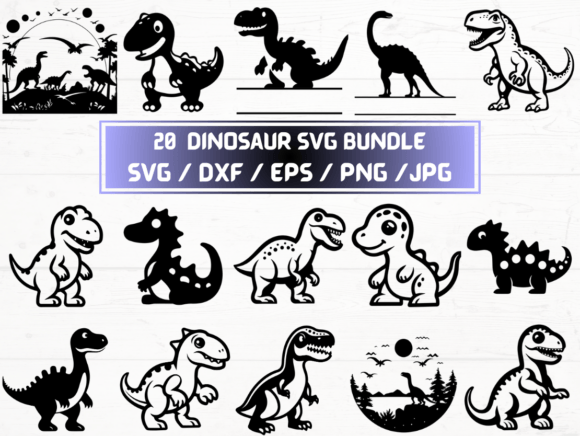
This listing delivers five distinct file formats—SVG, PNG, DXF, JPG, and EPS—each serving different workflows:
- SVG files: Best for web, Cricut, and most vector editors. Look for clean paths, named layers, and minimal anchor points—especially in small details like claws or teeth.
- DXF files: Essential for laser cutters and CNC machines. These must be true line-based drawings (not filled shapes). Some poorly converted DXFs embed fills or text as outlines, causing misreads during toolpath generation.
- PNG files: High-res, transparent-background raster images—ideal for digital overlays, lesson slides, or blog headers. Confirm they’re truly 300 dpi (not upscaled from 72 dpi).
- JPG files: Lower fidelity, no transparency—useful only when file size or platform restrictions demand it (e.g., certain email clients).
- EPS files: Legacy vector format. Still valuable for print shops using older RIP software—but avoid relying on them as your primary editing format.
Crucially, this set includes 20 of each, meaning you get matching versions across formats—not just 20 total files split unevenly. That consistency saves hours when switching between tools or collaborating with others.
Practical Tips Before You Download or Use Dinosaur SVG Files
Start by opening one SVG in your preferred editor—even if it’s free software like Inkscape or the browser-based Vectr. Zoom in. Try selecting individual parts: Does the stegosaurus plate move independently? Can you delete the background without affecting the silhouette? If not, the file likely wasn’t built for flexibility.
Next, test a DXF in Silhouette Studio or LightBurn. Import it, then check the Layers panel. Are there multiple layers labeled clearly (e.g., “cut_line,” “etch,” “shadow”)? Or is everything collapsed into “Layer 1”? Clear labeling isn’t cosmetic—it prevents accidental cuts or missed engraving steps.
If you’re using these for education or small business marketing, preview how the PNGs render on mobile. Transparency works reliably in most browsers and apps—but some older LMS platforms (like certain Moodle themes) display fallback colors. Keep a JPG version handy for those edge cases.
And remember: instant download means no physical item arrives—but also no customer service buffer. If the ZIP fails to extract, or files appear corrupted, double-check your download location and unzip method. Many issues stem from incomplete downloads or archive managers that don’t fully support ZIP64 (used for larger folders). Try extracting with the built-in OS tool first—before assuming the files themselves are faulty.
Better Choices Start With Smarter Checks
You don’t need advanced design training to use Dinosaur SVG Files effectively—you do need awareness of what each format does (and doesn’t) handle. Instead of asking, “Does this have a triceratops?” ask, “Can I recolor the triceratops *without* redrawing it?” Instead of assuming “20 files = 20 options,” verify whether those files support your actual workflow: cutting, printing, animating, or teaching.
One educator replaced a $40 clip-art subscription with this set—not because it was cheaper, but because the consistent naming (“dino_trex_front_view.svg”, “dino_trex_side_view.dxf”) let her build reusable lesson templates in under 10 minutes. A small-batch apparel maker used the DXF files to program precise fabric-cutting sequences—reducing material waste by 18% over her previous hand-traced method.
That kind of efficiency isn’t magic. It’s the result of choosing files built with real-world use in mind—not just aesthetics. When evaluating Dinosaur SVG Files, prioritize structure over quantity, clarity over complexity, and compatibility over convenience. Your future self—mid-project, on deadline, holding a half-cut vinyl sheet—will thank you.