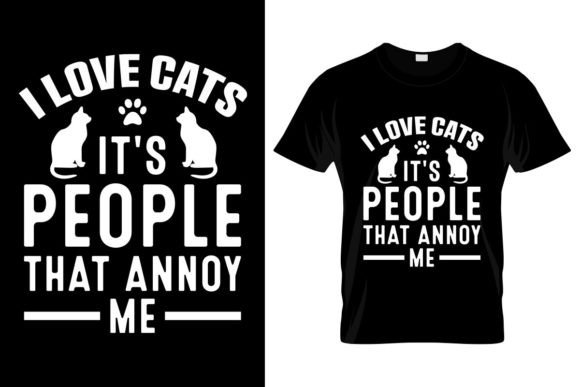
I Love Cats It's People That Annoy Me
The phrase I Love Cats It's People That Annoy Me expresses a lighthearted, relatable sentiment common among cat enthusiasts: deep affection for felines paired with mild social fatigue or introverted preferences. It is not a statement of misanthropy, but rather a humorous, self-aware reflection on personality traits—such as valuing quiet, authenticity, and low-demand companionship—that often align with cat ownership.
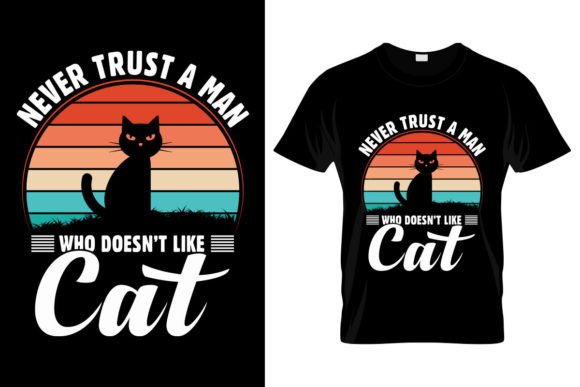
This sentiment has evolved into a widely recognized design motif, especially within print-on-demand (POD) and custom apparel markets. The I Love Cats It's People That Annoy Me t-shirt design is a typographic expression of that idea—clean, readable, and adaptable across products including t-shirts, hoodies, mugs, pillows, stickers, and journals. Its appeal lies in its specificity: it speaks directly to a niche audience without ambiguity, making it more resonant than generic cat-themed graphics.
Why Someone Might Consider This Design
Individuals exploring this design typically fall into one of several categories:
- Content creators building themed merchandise lines for cat-loving audiences on platforms like Etsy, Redbubble, or Amazon Merch.
- Small business owners curating gift items for pet stores, indie boutiques, or online shops focused on humor, pets, or introvert culture.
- DIY crafters and hobbyists using vector files for heat-transfer vinyl, sublimation, or screen printing on apparel and home goods.
- Self-publishers incorporating the design into low-content books, lined journals, or KDP interior layouts where thematic consistency matters.
The design’s strength is its dual function: it serves both as a personal expression and as commercially viable content. Its tone avoids edge or controversy while still feeling distinctive—important for standing out in saturated markets.
What You Receive and How It Supports Practical Use
The I Love Cats It's People That Annoy Me design package includes multiple file formats to accommodate diverse production needs:
- A print-ready PNG (4500×5400 pixels, 300 dpi, transparent background) suitable for high-resolution product mockups and direct printing on garments or mugs.
- An EPS file, ideal for professional vector editing and scalability without quality loss—especially useful for resizing across product types.
- A standard JPG file for quick previews, web use, or platforms that don’t accept vector uploads.
- An AI file (Adobe Illustrator), allowing full layer access and font editing if customization is needed.
- A PDF version, compatible with most design software and helpful for proofing or sharing with printers.
All files are delivered in a single ZIP archive, requiring extraction via tools like WinRAR or 7-Zip. This bundling reduces setup time and ensures compatibility across common workflows—from POD platform uploads to local print shops.
Benefits and Realistic Expectations
One key benefit is versatility: the design works equally well on black paper journals, light-colored cotton tees, or ceramic mugs. Its typography-first approach means minimal color adjustments are needed, reducing prep time before production. Because it relies on clean text rather than intricate illustration, it reproduces consistently across substrates—even on textured fabrics or curved surfaces like mugs.
However, users should recognize certain tradeoffs. As a text-based design, it offers less visual complexity than illustrated cat art—so it may not suit audiences seeking whimsical or narrative-driven themes. Also, while the phrase is widely understood in English-speaking markets, its humor depends on cultural familiarity with cat-owner stereotypes; international expansion may require localization or alternate phrasing.
Another consideration is market saturation. While the sentiment remains popular, similar phrases exist across platforms. Success depends less on novelty and more on execution: placement, typography refinement, product pairing (e.g., pairing with minimalist hoodie styles), and targeted marketing to communities that identify with the message.
When This Design Is a Strong Fit
This design is especially appropriate when:
- You’re targeting an audience already engaged with cat-related content—such as Instagram accounts focused on rescue stories, TikTok pages sharing cat behavior insights, or forums discussing indoor pet care.
- Your product strategy emphasizes personality-driven branding over seasonal or trend-based themes.
- You need a scalable asset that works across multiple SKUs without redesigning—e.g., applying the same graphic to a t-shirt, tote bag, and notebook line.
- You prioritize ease of integration: the inclusion of EPS, AI, and PDF files supports both automated POD workflows and manual prepress preparation.
It also fits well in contexts where subtlety matters—such as workplace-appropriate apparel for remote workers or educators who appreciate cats but prefer understated messaging over cartoonish imagery.
When Alternatives May Be Worth Considering
Consider other options if:
- Your audience leans toward visual storytelling—e.g., preferring illustrated cats in vintage style, watercolor, or line-art silhouettes over typography alone.
- You’re designing for children’s products, where simpler or more playful language—and imagery—may resonate more strongly.
- You require multilingual support or plan to adapt the phrase significantly (e.g., “I Prefer Cats to Meetings”); in those cases, starting from scratch or choosing editable templates with flexible copy fields may be more efficient.
- You’re producing limited-run physical items and need cut-ready SVG files for Cricut or Silhouette machines—though this bundle includes vector formats, confirm whether the specific SVG variant is included if cutting precision is critical.
Also note: if your goal is brand differentiation through unique voice, pairing this design with original supporting content—like short essays on quiet companionship or curated cat-care tips—can strengthen perceived value beyond the graphic itself.
Making an Informed Decision
To determine whether the I Love Cats It's People That Annoy Me design aligns with your goals, ask yourself:
- Does my target audience respond positively to dry, observational humor—or do they prefer warmth, nostalgia, or visual charm?
- Do I need flexibility across print methods (screen printing, DTG, sublimation) and products (apparel, home goods, stationery)?
- Am I comfortable working with layered vector files, or do I rely heavily on drag-and-drop POD interfaces that favor JPG/PNG uploads?
- Is this part of a broader collection—or a standalone piece? If part of a series, does the typography and tone match other assets?
Answering these questions helps clarify whether the design’s strengths match your operational capacity and audience expectations. It is neither universally optimal nor inherently limited—it is a tool whose usefulness depends on context, execution, and alignment with real-world use cases.